
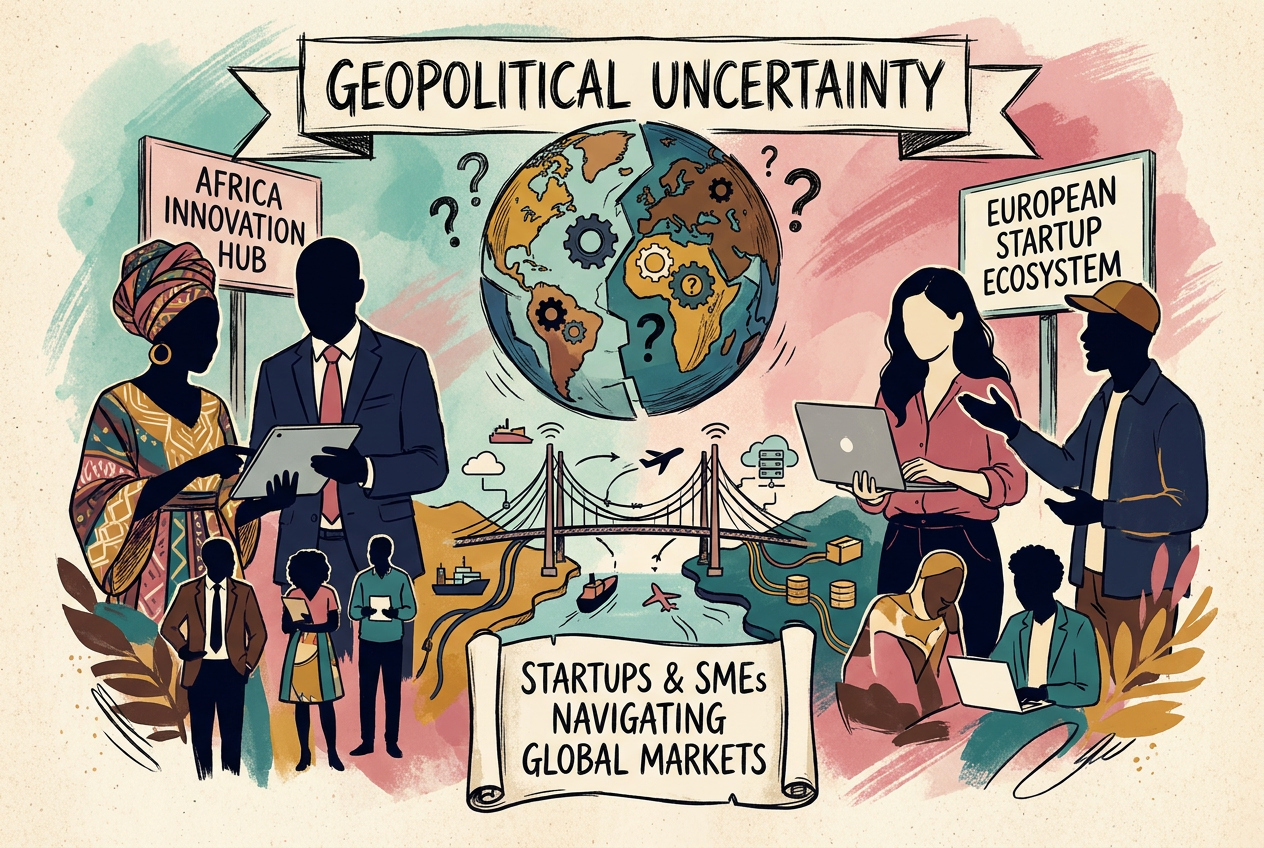

In an era defined by fluctuating trade policies, supply chain shocks, and shifting regulatory landscapes, geopolitical turbulence often appears to be a major threat to young businesses. However, history demonstrates that extreme friction also exposes massive structural vulnerabilities in traditional market leaders. Rather than retreating into defensive postures, forward-thinking entrepreneurs across Europe and Africa are actively reframing geopolitical instability as a strategic catalyst for groundbreaking venture creation.
In Europe, where dependence on external energy markets and cross-border supply networks has triggered severe operational bottlenecks, founders are building resilient, localized alternatives. Deep-tech and clean-energy startups across the continent are capitalizing on government pushes for strategic autonomy, securing significant capital to build near-shored manufacturing, sovereign cloud infrastructure, and localized renewable power systems. By turning national security concerns into commercial solutions, these companies are capturing high-margin enterprise contracts that previously went to global conglomerates.
Concurrently, African tech founders are navigating global currency devaluations and shifting international trade dynamics by building digital-first infrastructure tailored for self-reliance. Facing fragmented financial systems and cross-border friction, African fintechs and trade-tech platforms are enabling intra-continental commerce through localized cross-border payment networks and decentralized logistics platforms. By solving systemic inefficiency within high-friction environments, these startups are laying the digital infrastructure necessary to power trade under the African Continental Free Trade Area (AfCFTA).
The common denominator between successful European and African founders lies in their tactical approach to risk: they design for systemic adaptability from day one. Rather than relying on single, brittle supply channels or static regulatory frameworks, these leadership teams construct multi-node operations and agile compliance architectures. This structural flexibility allows them to pivot smoothly whenever regional policies change or traditional trade routes break down, turning volatility into a defendable competitive moat.
Furthermore, dynamic regulatory shifts present unprecedented tailwinds for early-stage companies that move faster than legacy players. As governments mandate stricter data sovereignty, local sourcing, and supply-chain transparency, nimble startups are uniquely positioned to comply rapidly and offer turnkey compliance tools to larger corporations struggling to adapt. What established corporations view as costly bureaucratic hurdles, innovative founders monetize as high-growth, business-to-business opportunities.
Geopolitical chaos is ultimately a reordering of the global economic map. The founders who build venture-scale businesses in the coming decade will not be those waiting for stability to return, but those who view uncertainty as an operational constant. By transforming systemic fragility into localized resilience, visionary European and African entrepreneurs are proving that the next generation of billion-dollar enterprises will be built directly out of regional disruption.
CDE, London.